

31, rue des Remparts d’Ainay…
(the garden of delights & wines)
Friday, November 20, 2026
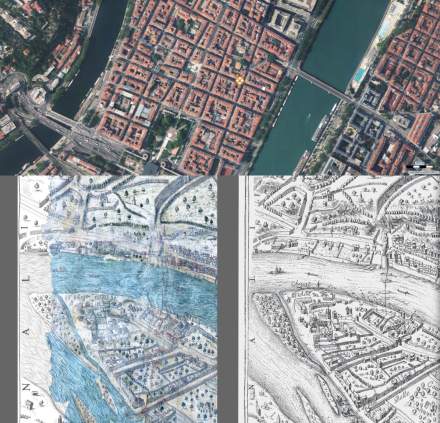
by Jérôme SABATIER, 20 November 2026, based on the transcriptions and records of archival deeds found in the documentary studies of the excavation reports for place Ampère and 22 rue Jarente. These reports were written by the Archaeology Department of the City of Lyon following two preventive excavations ordered by the DRAC (the regional directorate for cultural affairs).
The roof timbers of our dining room bear the date October 1643. A few minutes from our door, excavations took place on place Ampère and at 22 rue Jarente. Reading the reports, we went back as far as 1351, to the Plat d’Ainay. Jean Liatard held a vineyard there and owed, among other things, “un barral de vin pour le cellier d’Ainay”, a barral of wine for the Ainay cellar (read “a small barrel”). [1, 2, 9]
A barral for the cellar
The Plat d’Ainay lay in the south of the Presqu’île, near the abbey of Saint-Martin. The Sainte-Hélène road bordered, to the north, the lands mentioned in the deeds. To the south lay the brotteau (read “a sandy, marshy and wooded meadow”), on low ground by the water. In between, the abbey had gardens, meadows, orchards and vineyards. Jean Liatard’s vineyard adjoined the clos d’Ainay and another vineyard. The mention of the barral is found in Joseph Pointet’s record. [1, 2]
In 1370, Louis Liatard in turn acknowledged holding a vineyard on the Plat. The deed locates it in relation to the abbot’s vineyard, the sacristan’s, and the road from Saint-Michel to Sainte-Hélène. Louis’s name appears again in 1388 in the nommées, the registers in which the city recorded the property of the people of Lyon. He still held a large vineyard on the Plat. Reading these three mentions, one begins to understand how the lands of the abbey and those of private individuals were interwoven. [2]
The furrier and the carpenter
On 31 July 1493, two neighbours appear on the same folio. Pierre Bertrier, a pelletier (a furrier, who traded and worked furs), held a house and a vineyard. To the east, the carpenter Étienne Chappon also had a vineyard, next to a house with two dwellings. To the west of Bertrier lay yet another vineyard, on the Ainay side. In 1517, Claude Bertrier held a house, a small meadow and twenty-eight hommées of vineyard. The excavation report counts a little over four ares for one Lyon hommée. That makes about 1.2 hectares of vines. [3]
In April 1537, it was the turn of the barber Étienne Oret to declare his houses and his vineyard to the abbot. The notary gives the Sainte-Hélène road to the north and the Ainay meadow to the south. Another vineyard bordered his property to the east. To the west, Oret’s neighbour was the pastry cook Laurent Cornal, who also owned a house and a vineyard. Cornal made his declaration the following year. For him, Oret lies to the east. The road and the meadow are the same. The two men locate themselves by each other, just as we still would when explaining to someone where we live. [4]
What the Jesuits took from the garden
In 1544, work began on the Ainay rampart. A plan from 1753, compared with the present-day land register in the excavation report, shows that the wall ran at an angle across what is now place Ampère, in front of the tip of the Jesuit novitiate’s land. Rue des Remparts still follows part of this former city boundary. [5]
Vines and gardens coexisted. In 1576, Louise Henry, widow of Julien de la Bessée, acknowledged a house, a garden and an orchard. The abbot’s vineyard still appears among the lands bordering hers. In this part of Ainay, some vineyards had already given way to gardens and orchards. In 1606, the Jesuits bought the Abessée estate for their novitiate of Saint-Joseph. Their declaration to the abbot lists the house, its outbuildings, the garden and the orchard. [6]
In 1666, the fathers signed a contract with the master gardener Philibert Fornet. They insisted on taking the asparagus and artichokes from the garden within the enclosure. At the end of autumn, Fornet was to leave them chard, chicory, leeks and cabbages, among other things. Eleven years later, the rector described to the abbot the novitiate buildings, two gardens and orchards. In the same deed, he cites the declarations of the barber Oret, the pastry cook Cornal and Claude Berthier. A hundred and forty years had passed, and those old vineyards still appeared in the novitiate’s title deeds. [7]
At the corner of rue de la Charité
Leaving Les Bacchanales, you can walk up rue de la Charité towards Sainte-Hélène. Several of the deeds use this road to locate a vineyard. Emmanuel Vingtrinier dates the extension of rue de la Charité to the ramparts to 1747. Today’s corner is therefore a little over a century later than the date inscribed on our roof timbers. [4, 8, 9]
The archaeologists were able to trace the plot at 22 rue Jarente from the 1831 land register back to the medieval deeds. For the land on which our house stands, that line of descent remains to be found. The deed that names the cellar predates by nearly three centuries the date we read on the wood. [2, 9, 10]
We chose to call our restaurant Les Bacchanales because of the place wine holds in it. We discovered the barral long afterwards. What we love about this old register is that it even names the cellar. In Ainay, wine already had its address.
Sources and references
1. The barral of 1351. Éric Bertrand et al., 46, rue Victor-Hugo / place Ampère, excavation report by the Service archéologique de la Ville de Lyon, December 2014, documentary study by Adam Roux, pp. 45 and 48–49, document 1. Record by Joseph Pointet, Archives municipales de Lyon (AML), 37 II 020, p. 5585. Place Ampère report
2. The vineyards of the Plat d’Ainay and the Liatards. Éric Bertrand et al., 22, rue Jarente, excavation report, 2016, documentary study by C. Nivelon, pp. 67–71. Archives départementales du Rhône (ADR), 11 G 423, fol. 6v (1351) and fol. 36 (1370). AML, CC 1, fol. 175v (1388). The report follows plot 324 of the 1831 land register and notes its grouping with plot 323 in the register’s matrix. Rue Jarente report · Readable text · Inventory of the nommées
3. Bertrier and Chappon. Rue Jarente report, pp. 67 and 71–73. AML, CC 8, fol. 31v (31 July 1493) and CC 36, fol. 58 (1517). Equivalence given in the report for one Lyon hommée: 4 ares and 31 centiares. Rue Jarente report
4. Oret and Cornal. Rue Jarente report, p. 73, notes 35 and 36. ADR, 11 G 433, fol. 44v (10 April 1537) and fol. 51v (7 August 1538). Rue Jarente report
5. The ramparts and place Ampère. Éric Bertrand et al., 16, rue Bourgelat, excavation report, 2011, study by Cyrille Ducourthial, § 3.2.1, p. 75 ff. Place Ampère report, pp. 46–47 and pl. 11, for the comparison between the 1753 plan géométral and the land register. Rue Bourgelat report · Place Ampère report
6. Louise Henry and the novitiate. Rue Jarente report, pp. 68 and 72. AML, 37 II 020, Pointet collection, record 5585 (acknowledgement of 29 December 1576). ADR, 11 G 443, fol. 29v (acknowledgement of 19 May 1606). Rue Jarente report
7. The Saint-Joseph garden. Rue Jarente report, pp. 74–75, notes 39 and 40. ADR, 18 H 22 (agreement with Philibert Fornet, 26 April 1666) and 11 G 469, fol. 9v (acknowledgement by the novitiate, 12 January 1677). Rue Jarente report
8. The extension of rue de la Charité. Emmanuel Vingtrinier, Le Lyon de nos pères, chap. III, passage on the Sainte-Hélène reclusory and the Pénitents de Saint-Charles. Digitised page
9. The Bacchanales building. The Bacchanales website gives the address and the date inscribed on the roof timbers. The order of the Lyon Administrative Court of 28 June 2024 gives the double address, 31 rue des Remparts d’Ainay and 40 rue de la Charité. Les Bacchanales · Court order
10. The plot still to be identified. ADR, Lyon land register, section L (Ainay), third sheet, 1831, 3 P 968 (digitised as 2 Num 12/968). Terrier de Loÿs, 1620, 11 G 444, and terrier de Raval, 1665, 11 G 445. The terrier references have been checked against the chapter’s inventory. Land register inventory · Inventory of the Ainay chapter